
The Foundation.
Beyond the Buzz: Build AEC Brand Authority Alongside AI Adoption

Length
4 min read
Topic
AEC Website Design
The AEC industry is at an inflection point, with AI on everyone’s mind. Just as the shift from hand-drafting to CAD redefined what a competitive firm looked like, artificial intelligence (AI) is now doing the same. The firms that communicate their AI adoption journey clearly and credibly are building brand equity that goes far beyond project portfolios.
While many firms are *doing* the work to adopt AI and technology into their workflows quietly, their brand messaging stays stuck in 2015. That’s a missed opportunity both for winning clients and attracting the next generation of talent.
Why AI & Technology Adoption Is Now a Brand Signal
AI adoption in AEC ranges, but early adopters already see returns such as saving significant budget and time in their work. Those are client-facing outcomes. Clients are also starting to ask the right questions: How are you using technology to deliver my project better, faster, and with fewer surprises?
At the same time, the global AEC market is growing rapidly, and competition for both clients and skilled professionals has never been more intense. In this environment, your firm’s stance on AI isn’t just an operational decision, it’s a positioning decision.

The Client Benefit Case: Delivering Certainty at Scale
Clients don’t buy an AEC firm’s AI, they buy outcomes. On-time delivery, accurate budgets, fewer RFIs, and buildings that perform as designed. The smart brand move is to translate your AI capabilities directly into your firm approach that secures the best results.
AI technologies enable architects, engineers, and construction managers to work more closely together through centralized platforms for sharing data and insights, leading to better communication, fewer misunderstandings, and more successful projects. New technology in drones improves surveys, speeding up progress and ensuring accuracy. That’s your client pitch: less friction, more transparency.
AI-driven tools allow architects to quickly explore variations based on parameters like budget, materials, lighting, and space utilization. These improvements mean clients get optimized solutions faster, not just faster iterations of the same solution.
Critically, AI can bridge the gap between design and construction that can stall major projects, keeping work on track when changes occur as a natural byproduct of simultaneous workflows. Firms like Bechtel have already deployed AI change-management agents that evaluate scope shifts in real time, the kind of capability that directly reduces the cost overruns clients fear. Whether a firm is Design-Build or not, incorporating cross-functional collaboration from architecture to construction is an important differentiator to clients who want the smoothest delivery possible.
Always lead with the problem you’re solving, not the tool. “We use AI to catch coordination conflicts before they reach the field” lands harder than “we use machine learning.”
The Talent Benefit Case: Becoming the Firm Where Careers Grow
The talent dimension of AI adoption is just as strategically important and far less discussed.
AI is shaping on-site and in-office job experience and there is an opportunity for technology to shape career growth. As experienced AEC professionals retire, the new generation of leadership must also be expert adopters and managers of technology in addition to holding domain best practice and experience. This is a critical moment where institutional leaders and AI learners can intersect to hand off institutional knowledge while also navigating technological adoption.
Similarly, new hires want to leverage cutting edge technologies they come to expect, while also learning from veteran professionals. Maintaining some overlap between institutional ways of working alongside technological adoption is the magic balance. The future will have AI embedded, but real-life experience will always be needed too. For a firm’s employer brand, highlighting AI’s role in career trajectories is powerful: you’re not just offering a job, you’re offering accelerated learning at a pivotal moment.
Top graduates and mid-career professionals increasingly evaluate employers on their technology adoption. A firm that communicates a clear, structured approach to AI adoption signals that it invests in its people’s growth, not just its project pipeline. It also signals stability; the firms that embrace AI, invest in data infrastructure, and commit to sustainability will define the next era of the built environment. Those that do not will find themselves competing for a shrinking share of an industry that has moved on without them.
Showcase AI not as automation but as career amplification. Highlight how your team uses AI to work on higher-value challenges, that is the interesting work that attracts ambitious professionals.

How to Communicate AI Adoption Credibly Through Your Website
Authentic AI storytelling on your AEC website follows a clear framework:
- Clarify your approach: Across all projects, your firm has a distinguished approach. AI and technology are now an important part of that story, rather than the story itself.
- Share what AI delivered: hours saved, errors caught, delivery time reduced. Quantified outcomes build credibility far faster than capability claims.
- Spotlight technology as a career differentiator: Your website is a top recruiting tool for AEC firms. Integrate how technology and AI play into employees’ career trajectory. Not as a replacement, but as tools that will define the future of work alongside veteran expertise.
- Establish your thought leadership: As more AEC firms adopt AI, peer-to-peer thought leadership is crucial validation and information sharing. Become a confident voice in AI and technology adoption through a blog. In addition to establishing industry leadership, continuous content on the subject helps clients feel confident in your responsible approach to technology and AI and the positive project outcomes that help your firm stand out.
- Highlight AI impact in your portfolio: Each project case study is a story not only in what you designed and built, but how you did it. Adding content on AI and technology tools, from aerial drones that improve site mapping to workflow tools that increase speed and accuracy of project delivery, show the impact of the tools your team uses to improve project outcomes.
- And still, keep in human: AI is increasingly viewed as an amplifier of expertise rather than a replacement for human skills. This framing resonates with clients who want experienced professionals in the driver’s seat, and with employees who worry about their own relevance.
The Brand Opportunity Is Now
The firms that embrace AI early will gain a significant advantage in speed, quality, and innovation. The firms that communicate that embrace clearly and consistently will gain something equally valuable: a brand that stands for progress and has the results to back it up.
Your AI adoption story, told with specificity, humility, and a focus on outcomes, is one of the most powerful brand assets your firm has right now. The question isn’t whether to tell it. It’s making sure that the impact lands for clients and the industry through actual results.
Don’t Forget to Leverage AI for Marketing
In addition to your project work, AI is an important factor in how your firm reaches audiences in the first place, requiring strong search engine optimization. With increasing adoption of AI search for AEC firms, it is paramount to factor in a solid Answer Engine Optimization (AEO) strategy in addition to traditional SEO. Luckily, many of the same best practices apply: keywords, url structure, and content to help with discoverability. With the increasing power of LLMs to understand context, it is important to share authentic examples that help paint a nuanced picture of how your firm uses AI and technology to improve project results for clients. Finding ways to integrate keyword research into website content, and creating ongoing thought leadership, will help search engines of all types make connections to your site. Doing so in a way that authentically represents how your team continues to adopt technology, and how it positively impacts results, strengthens the human connection with audiences reading it.
Want to learn more?
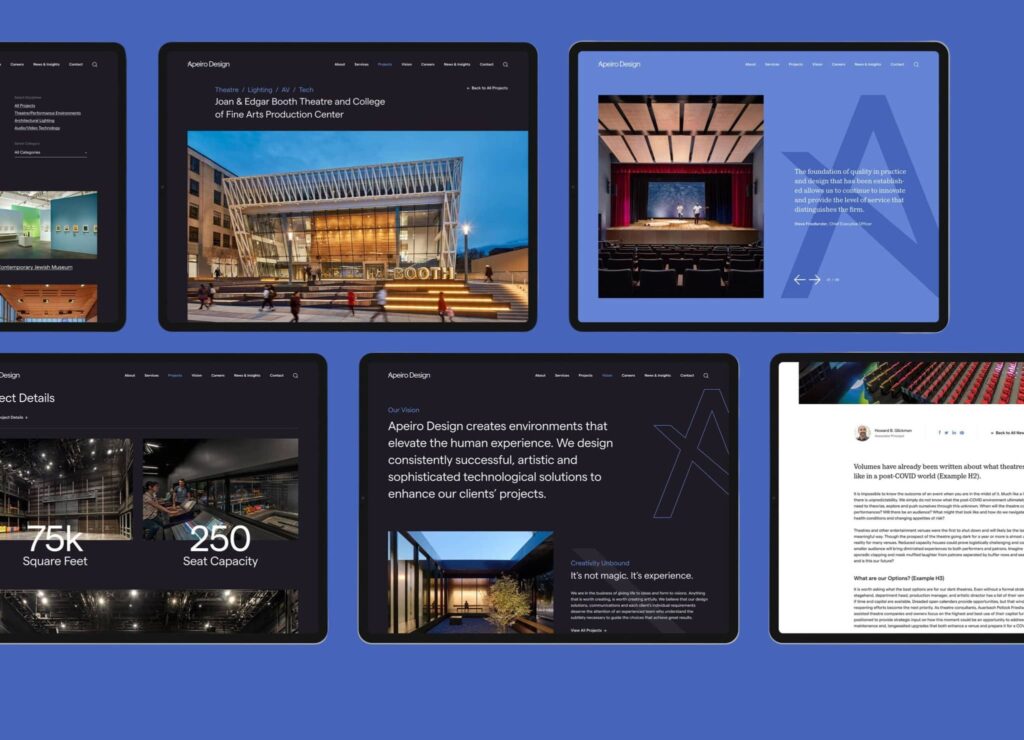
Clients don’t need to see your internal operations, they need to understand how you operate through you brand. Your website is an always-on resource for prospective clients, employees, and industry peers to see how your firm is taking the lead in improving project timelines, budgets, and outcomes. Make sure it reflects the technology-informed approach your team has, backed by tenured human experience.
We’re here to help. Reach out and we’d be happy to review your current site and discuss how we can help you level up and prepare your brand and website for the future.